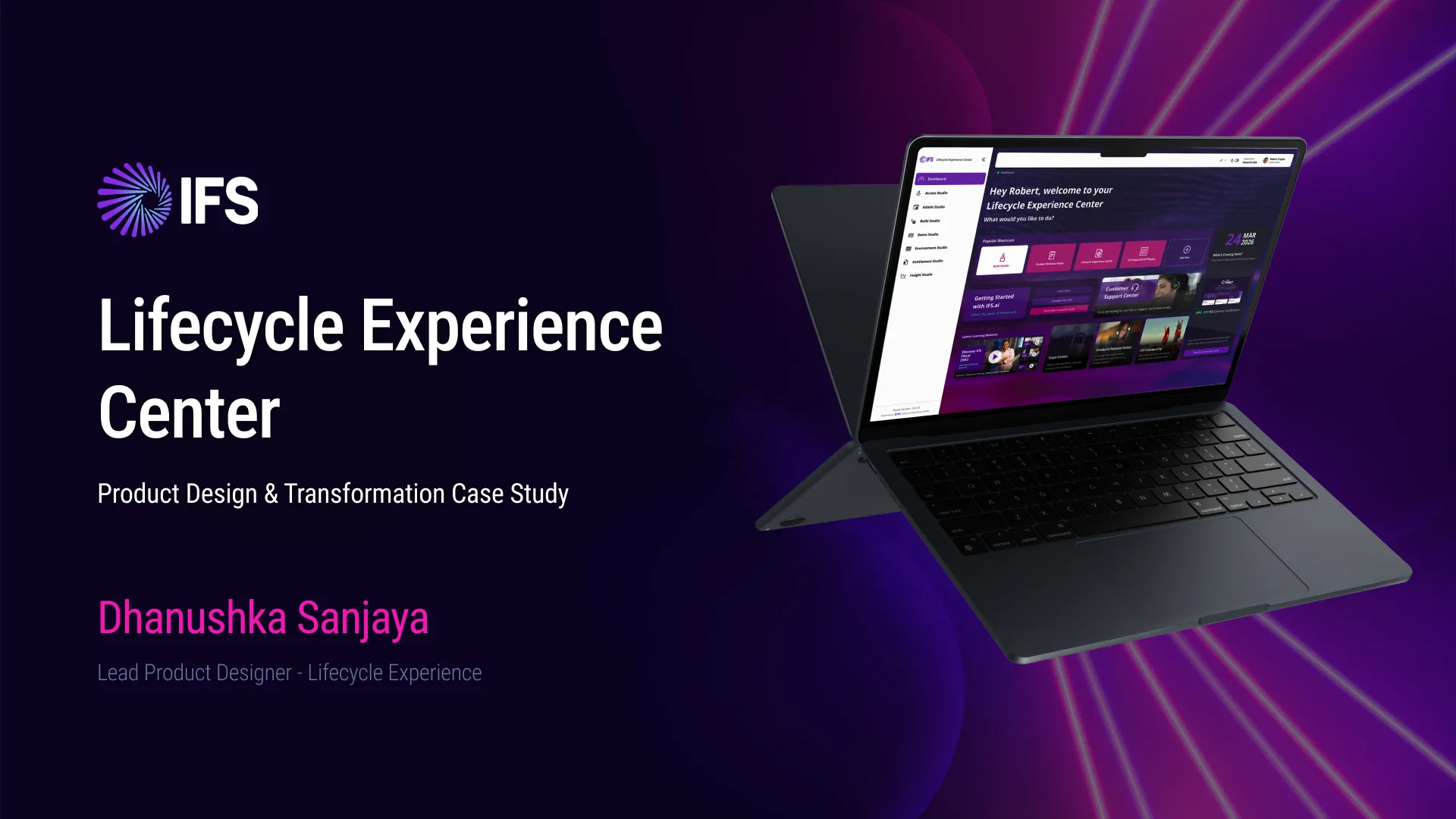
Lifecycle Experience Center: a live product transformation
The central hub that all 6,000+ IFS customers use to manage their software lifecycle every day. I led the design transformation of a legacy single application into a unified, self-service platform across two fast-paced releases, while every live enterprise customer kept working without disruption.
From one application to the hub for a whole software lifecycle.
Customers use the Lifecycle Experience Center (LEC) to get service and release updates, manage production and non-production environments, track IFS.ai token consumption, deploy deliveries into environments, and manage service and user access.
Two years ago it was the Application Lifecycle Experience (ALE), a single application for managing customisations and getting new updates. This case study covers how we turned it into a unified, self-service hub, live, with 6,000+ enterprise customers using it every day.
The problem, and where we wanted to go.
- Customers had to move between different platforms and products to manage their lifecycle, which made the experience inconsistent and inconvenient.
- UX concerns ran across the whole product, so they had to be solved at product level, not screen by screen.
- Limited self-service meant more manual work for customers and more load on support.
- Outdated technical limitations had to change to lay the foundation for the NEXTGEN architecture.
- Consolidate the full customer lifecycle into one central, self-service hub.
- Resolve existing UX concerns and bring accessibility and responsiveness up to a mobile-compatible level through a new design system.
- Deliver a seamless product transformation while live customer services run uninterrupted.
- Standardise connectivity to the central application through service platforms and a shared front-end component library, all following one design system.
Application Lifecycle Experience → Lifecycle Experience Center.
Two menus, one clear path.
Despite the platform's complexity, a dual menu system lets users switch between features and applications seamlessly, on any device.
A fast, iterative transformation across two releases.
The work was phased to secure time to market: lock the concept early, ship a first iteration, then complete the migration and measure success after release.
Project roadmap
Workshops and service maps.
My contributionBrainstorming, pitching UX concerns and input for the concept.
Transformation plan and first iteration.
My contributionBrand approval, recruiting and onboarding the UX project team, the foundation of the new design system and the UI for iteration 01.
Front-end migration, full migration and extended self-services.
My contributionUX of new self-services, overseeing and evolving the design system, and leading the customer experience transformation.
Measure success.
My contributionManaging FullStory insights, UX of new self-services and securing UX quality standards.
Project timeline
- Nov 2024Discovery and vision
UX scan, leadership alignment, mood boards and concept prototypes.
- Jan 2025Design system foundation
Atomic components, tokens, theming and responsive rules established.
- Mar 2025Design and implementation review
Redesigned the existing application's interfaces, developer hand-off and implementation review.
- May 2025Experience transformation and release 1
Built awareness through educational materials and support.
- Jul 2025Design phase 02 scope
Designs for new self-services, an evolved design system and design validation.
- Nov 2025Full product transformation, release 2
Developer hand-off, user awareness and support.
- Feb 2026Refinements and post-analysis
FullStory analysis to measure success and drive refinements.
One token-based system for every studio.
I adopted the existing IFS design system and defined what was missing for LEC. The result is a token-based system that scales to current and future requirements.
LEC design tokens = IFS design tokens + LEC branded new tokens
Typography · Inter, 100% line height, −0.25px letter spacing
Mobile is first-class, not a breakpoint.
The new designs hold up from wide desktop to phone. Responsiveness comes from the component level, so every screen built from the system inherits it.
More than a re-skin.
Alongside the rebrand, we improved the actual UX of key areas, grounded in insights and feedback.
More visual progression, room to scale to a longer activity history, and improved readability scores.
Live customer transformation, zero impact.
What customers said in the Voice of Customer survey after the 25R2 release:
"The overall user experience is good. It is hard to make a mistake and you are generally guided in a very good way."
"I like the new dashboard having the links to additional resources and portals such as training, community and the developer portal."
"The Environment Studio made life easy with more control through the interface to my environments."
A transformation that grew me as a lead.
Leading LEC meant working at speed, making high-impact planning and execution calls, managing resources and the backlog, and staying aligned with senior leadership throughout.
- Designing an adaptive, scalable token-based design system for current and future requirements
- Timeline restrictions and framework limitations
- User experience impact from transforming a live product
- Designing improvements to existing features and new features from scratch
- Distributing work in parallel while keeping the experience consistent
- Managing UX resources based on the available skill sets
- Keeping senior leadership aligned on progress and deviations
- Technical infrastructure limits on the best possible UX
- Keeping UX best practice in the team at high project velocity
- Negotiating between the conceptual vision and its UX impact
- Building a token-based design system by adopting an existing one and defining what was missing
- Managing designers with different skill sets and mindsets to get the best from each
- Planning design sprints for fast-paced projects and tracking progress
- Real-world situational decisions to reduce risk to design milestones
- Negotiating and communicating effectively with senior leadership
- A user education and support plan for a product transformation
- Defining MVP scopes that reach the ultimate UX goals iteratively
- Overseeing developer collaboration across parallel projects